A quote that says “Belgard pavers” has named a manufacturer and told you almost nothing else. It does not say which unit, how thick it is, what base it sits on, or how carefully it will be laid — and those three things, not the logo on the pallet, decide whether the driveway is still flat in fifteen years.
Belgard is one of the largest paver brands in North America, and the range is broad. That breadth is the problem: the same brand covers a 30 mm overlay tile, a 60 mm patio paver and an 80 mm driveway unit, and they are not interchangeable. A brand name is not a specification.
What “Belgard pavers” actually covers
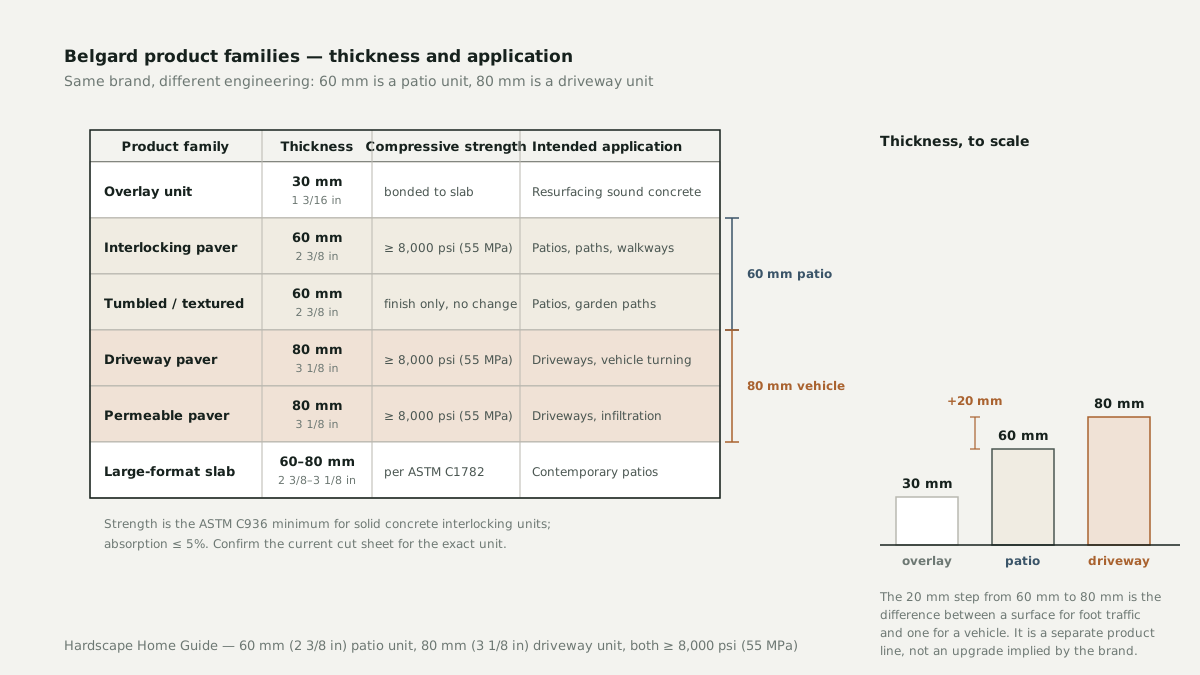
The range divides into families engineered for different jobs. On a typical install, the pallet label and cut sheet are the only places that distinction is visible.
- Overlay units, 30 mm (1 3/16 in). The Appian-Stone Tile and Catalina Slate overlay lines. Bonded to sound, uncracked concrete with adhesive, not bedded on sand — a resurfacing product, not a paving one.
- Interlocking pavers, 60 mm (2 3/8 in). The patio and walkway workhorse — Holland Stone, Cambridge Cobble, Brooklyn Paver, Dublin Cobble, Avalon Slate. Belgard approves 60 mm for residential vehicular use, but it sits at the light end of that.
- Driveway pavers, 80 mm (3 1/8 in). The same shapes at greater depth, and the units for a driveway, a turning area, or anywhere a delivery truck goes.
- Permeable pavers, 80 mm. The Aqua lines — Aqua-Bric, Aqua Dublin — with wider joints over an open-graded base, for infiltration.
- Large-format slabs. Dimensions, Cortez Slab, Delta Texada Plaza Slab. Bigger faces, heavier units, a thicker base and tighter bedding tolerances.
- Retaining wall systems. A separate family with its own engineering. Nothing about a wall block carries over to a paver.
Two of those families are for patios and two for driveways, and the brand name does not say which you were quoted. The matrix below sets them against each other by thickness, strength and application.
The properties that decide whether it lasts
Strip the brand away and four numbers govern performance: compressive strength, water absorption, thickness and freeze-thaw durability. The first three come from the product standard; the fourth comes from where you install it.
| Property | What to demand | Standard |
|---|---|---|
| Compressive strength | ≥ 8,000 psi (55 MPa) average | ASTM C936; CSA A231.2 |
| Water absorption | ≤ 5% average | ASTM C936 |
| Thickness, driveway | 80 mm (3 1/8 in) | ASTM C936 |
| Thickness, patio | 60 mm (2 3/8 in) | ASTM C936 |
| Large-format slabs | 60 mm and above, heavier unit | ASTM C1782 |
| Permeable units | Grid or open-joint system | ASTM C1319 |
ASTM C936 gives the minimums for solid concrete interlocking units. CSA A231.2 covers the same ground for the Canadian market and adds its own freeze-thaw classes. In Australia and New Zealand the product standard is the AS/NZS 4455 series, with test methods in the AS/NZS 4456 series — there is no freeze-thaw class because the design case does not arise.
Ask for the manufacturer’s current test report rather than a brochure. A cut-sheet figure is a type test on a sample, and a plant can change aggregate source between production runs. The test report is the specification; the brand name is not.
60 mm or 80 mm — thickness is the specification
Thickness is the one property a homeowner can check on the pallet, and the one that matters most under a vehicle. A paver does not carry a wheel load; it spreads it. A thicker unit spreads that load over more base, so the subgrade sees less stress per pass.
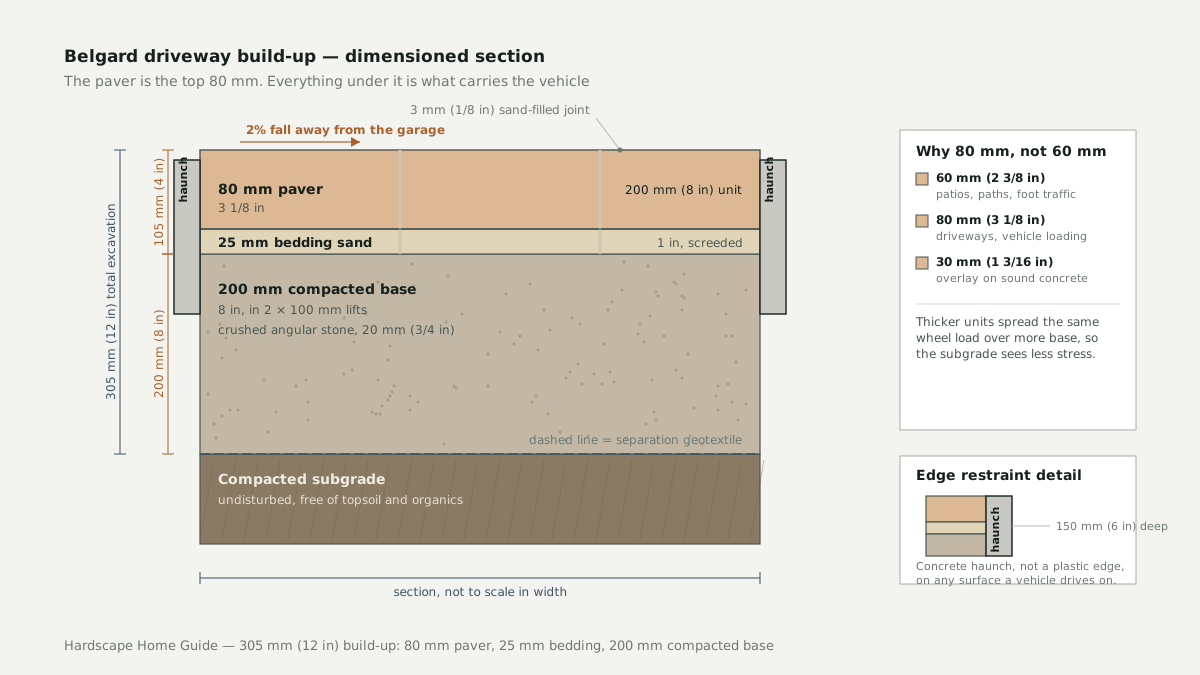
Belgard’s own product pages make the division explicit: 30 mm is an overlay on sound concrete, 60 mm is approved for residential vehicular use, and 80 mm is the commercial grade. In practice, 60 mm is the wrong unit for a driveway that takes a turning vehicle, a boat trailer or a delivery truck.
What the base has to be
Below the paver sits 25 mm (1 in) of screeded bedding sand and 200 mm (8 in) of compacted crushed angular stone, placed in two 100 mm lifts, compacted between them. The base does the carrying. An 80 mm paver over 100 mm of base fails faster than a 60 mm paver over 200 mm, because the load has nowhere to go. Edge restraint — a concrete haunch, not a plastic edge — is what stops the field spreading under repeated loading, and it is standard on anything a vehicle drives on.
Pattern: where the labour and waste go
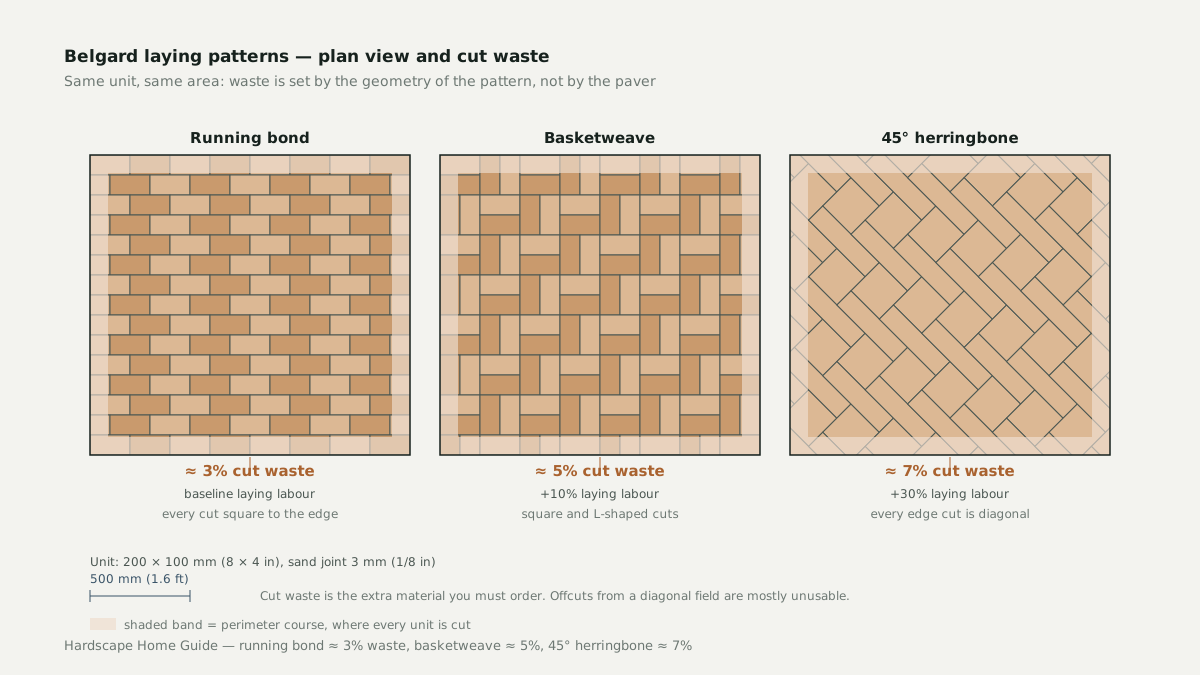
Pattern is the largest controllable cost difference between two otherwise identical jobs, because it changes both the laying time and the quantity of material you have to buy.

| Pattern | Cut waste | Laying labour | Interlock |
|---|---|---|---|
| Running bond | ≈3% | Baseline | One direction |
| Basketweave | ≈5% | +10% | Moderate |
| 90° herringbone | ≈6% | +20% | Two directions |
| 45° herringbone | ≈7% | +30% | Two directions |
Waste is extra material you must buy, not material thrown away. Order the percentage as additional units rather than assuming it is inside the price.
On a 500 ft² driveway, the gap between running bond and 45° herringbone is typically $700–$1,500 in material and laying time. Herringbone earns some of that back on a driveway: it interlocks in two directions and resists tire push and the downward creep that affects running bond on gradients above about 5%. On a patio, it buys nothing structural.
The six numbers to demand from every quote
Two paver quotes can differ by 300% for a surface that looks identical on completion day, because they differ on the parts you cannot see. Ask every contractor for the same six numbers.
- Excavation depth — total depth removed, in mm or inches.
- Base depth and lift count — compacted thickness, and how many lifts it goes in.
- Compactor type — a plate compactor for base, or a vibratory roller.
- Edge restraint — concrete haunch or spiked edge, and whether it is included.
- Joint sand — standard, polymeric or resin, and whether it is included.
- Waste allowance — the percentage of extra material priced.
Joint sand, dye lots and finish
Joint sand is what locks the field together. Without it, pavers move independently and the pattern opens at the perimeter first.
| Type | Cost | Best for | Watch out for |
|---|---|---|---|
| Standard sand | Lowest | Sheltered patios | Washes out, needs topping up every 2–3 years |
| Polymeric sand | 2–3× standard | Driveways, slopes | Hazes the surface if the install is rushed |
| Resin jointing | Highest | High-traffic, permeable | Higher material cost, needs dry conditions |
Polymeric sand is activated with water and sets semi-rigid. It is unforgiving of a rushed install — residue left on the paver face sets hard and is very difficult to remove.
Dye lots and production runs
Color is the one part of the specification that is genuinely cosmetic and genuinely hard to control. A paver is pigmented in a batch, and the batch shifts. Two pallets carrying the same color name, produced months apart, will differ — sometimes obviously, once laid next to each other in sunlight.
Phased installs are where this goes wrong. If you pave the front of a driveway this year and the apron next year, either order the whole quantity at once and store it under cover, or accept a visible seam. Keep 2–3% of the order as spares, stored out of the sun. A paver bought three years later will not match, even in the same color name.
Tumbled and textured are finishes, not upgrades
A tumbled paver is the same structural unit with a distressed edge; a textured or shot-blast finish changes the face only. Neither changes compressive strength, absorption or thickness. They cost more because of the extra process, and they read as an older, more settled surface. Specify them for appearance — but never let a tumbled 60 mm unit stand in for the plain 80 mm unit you needed.
Freeze-thaw, salt and climate
Water absorption is the freeze-thaw property. Water that soaks into a unit expands as it freezes, and a saturated paver in a cold climate scales from the inside out. That is why the ≤ 5% absorption limit matters far more in Canada and the northern US than in Australia or New Zealand, where the AS/NZS standards carry no equivalent class because the design case does not arise.
Two things raise the risk further in a cold climate:
- De-icing salt. Sodium chloride and, worse, calcium chloride lower the freezing point of water and drive more freeze-thaw cycles through the surface. Salt also attacks the cement matrix directly. Use sand or grit for traction; if you must salt, use it sparingly and rinse in spring.
- Shade and standing water. A driveway that holds meltwater against a shaded edge will spall there first. The 2% fall away from the garage is a durability detail, not just a drainage one.
In Australia and New Zealand the equivalent stress is heat and UV rather than frost. Lighter-colored units stay measurably cooler underfoot on a west-facing driveway, and darker colors fade faster under high UV regardless of brand.
When concrete is the better buy
Worth saying plainly: on first cost, pavers lose. A poured concrete patio runs about $6–$14/ft² installed against $10–$25/ft² for pavers, and it needs less base preparation. A stamped concrete surface delivers a comparable look for 20–40% less up front. If budget is the deciding factor and the subgrade is stable, concrete is the rational choice.
Pavers win on three things, and all three are about movement. They tolerate a subgrade that shifts, because each unit moves independently instead of cracking as one sheet. They are repairable. And they can be built permeable. On a paver driveway with tree roots, a slope, or a clay subgrade that heaves, that repairability is what you are paying for. The paver patio build-up guide sets out the same layers for a surface that only takes foot traffic.
Lifting and replacing a damaged unit
This is the advantage pavers hold over any poured surface, and worth knowing before you need it.
- Scrape the joint sand out around the unit with a narrow scraper or an old screwdriver.
- Work two flat-blade screwdrivers or a purpose-made paver extractor down opposite edges.
- Lift vertically and evenly. Levering from one side is what snaps the unit.
- Scrape the bedding sand level and re-screed it before seating the replacement. Do not add loose sand to fill a void — it compacts later and leaves a dip.
- Seat the replacement, re-sand the joints, and compact with a rubber mallet or a plate compactor fitted with a pad.
If several adjacent units have sunk rather than cracked, the fault is in the base underneath, and replacing units will not fix it. Lift the area, correct the base, and relay. The diagnosis is the same whether the surface is a driveway or a patio.
Frequently asked questions
Is Belgard better than other paver brands?
Belgard is one of several large manufacturers with comparable engineered products, and its 60 mm and 80 mm units are held to the same ASTM C936 minimums as any other brand. What matters more than the name is the specific unit's compressive strength, absorption rate and thickness for your application, plus the installer's base preparation. Ask for the manufacturer's current test report rather than the brochure.
How much do Belgard pavers cost per square foot?
Material typically runs $3–$8 per square foot, and installed cost lands between $10 and $25 per square foot depending on pattern, site access and region. Premium tumbled and large-format lines sit at the top of that range. A 500 ft² driveway therefore runs roughly $5,000–$12,500 installed.
Which Belgard laying pattern wastes the least material?
Running bond wastes least, around 3%. Basketweave runs about 5%, 90° herringbone about 6%, and 45° herringbone about 7% because every perimeter cut is diagonal. Order the waste percentage as additional units rather than assuming it is inside the price.
How thick should Belgard pavers be for a driveway?
80 mm (3 1/8 in). Belgard approves 60 mm units for residential vehicular use, but 60 mm is the wrong unit for a driveway that takes a turning vehicle, a boat trailer or a delivery truck. The 80 mm unit sits over 25 mm of bedding sand and 200 mm of compacted base, a total excavation of 305 mm (12 in).
Sources and references
- Belgard — product lines, cut sheets and technical documentation
- Concrete Masonry & Hardscapes Association (ICPI and NCMA) — paver installation guidance
- ASTM International — C936 solid concrete interlocking paving units, C1782 paving slabs, C1319 grid paving units
- CSA Group — CSA A231.2 precast concrete pavers
- Standards Australia — AS/NZS 4455 pavers and AS/NZS 4456 test methods
