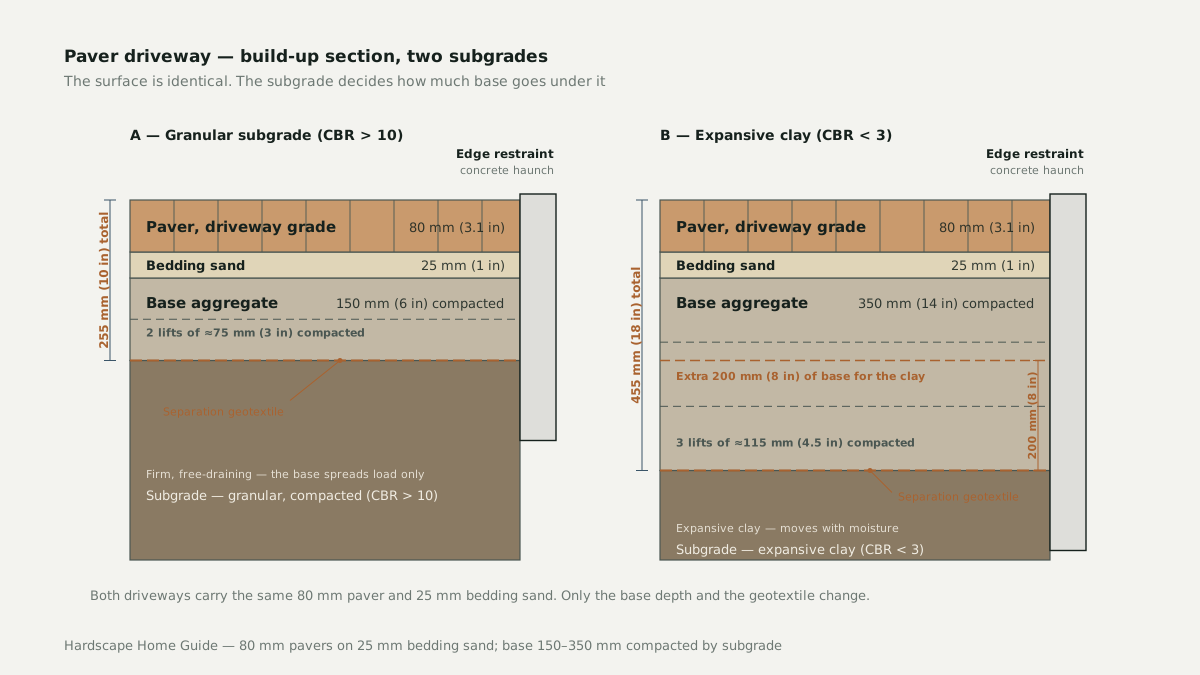
Driveway pavers and patio pavers can look identical on handover day and be built to completely different specifications. The difference is the base: its depth, the lifts it was compacted in, and the restraint holding the edges. Get those right and the driveway is serviceable at 25 years. Get them wrong and it ruts within three winters, with the pavers still perfect.
What a driveway asks that a patio does not
A 2-tonne (4,400 lb) car on four contact patches puts roughly 30 psi (≈200 kPa) on the surface — about its tire pressure, and less than a person in stiletto heels. Weight is not the problem. Repetition is: thousands of wheel passes a year in the same two tracks, against a few hundred footfalls on a patio. Horizontal force is the second — turning at full lock and braking scrub the surface with shear a footpath never sees, and that is what racks a pattern that interlocks in one direction only. Water and salt are the third.
Base depth is a calculation
Depth follows the subgrade’s bearing capacity, expressed as a California Bearing Ratio (CBR) — the soil’s resistance relative to crushed stone, tested to ASTM D1883 or AS 1289.6.1.1. Granular soil above CBR 10 behaves; plastic clay at 3–5 does not; expansive clay below 3 moves with every wet and dry season. The difference in depth is not small.
| Subgrade | CBR | Base, compacted | Base, loose | Total build-up |
|---|---|---|---|---|
| Granular, drained | > 10 | 150 mm (6 in) | ≈200 mm (8 in) | 255 mm (10 in) |
| Firm plastic clay | 3–5 | 250 mm (10 in) | ≈335 mm (13 in) | 355 mm (14 in) |
| Expansive clay | < 3 | 350 mm (14 in) | ≈465 mm (18 in) | 455 mm (18 in) |
| Fill or soft spots | Variable | 350–450 mm (14–18 in) | ≈465–600 mm (18–24 in) | 455–555 mm (18–22 in) |
Total build-up includes the 80 mm paver and 25 mm bedding sand. Loose depth assumes a well-graded base bulked about a third above compacted volume.
The 25 mm (1 in) bedding layer is a screeded setting bed, not structure — count it as base and the base is 25 mm thinner than the quote claims.

If nobody has tested the soil, ask for a dynamic cone penetrometer result (ASTM D6951) or a proof roll with a loaded tandem truck. Soft spots pump and rut; each one gets excavated and replaced, not covered.
Why driveway units are 80 mm
Thickness is a load rating. The 60 mm (2.4 in) unit is the pedestrian standard and correct for a patio; a driveway takes the 80 mm (3.1 in) vehicular unit, because bending resistance rises with the square of thickness, so 80 mm to 60 mm costs about 45% of a unit’s stiffness. The failure is not a broken paver — it is corner spalling and a rocking unit under a turning wheel, which lets water into the bedding sand. It is the most common substitution in the trade, and a regional one: in Australia and New Zealand, 60 mm units are routinely sold as driveway pavers, and AS/NZS 4456, ASTM C936 and CSA A231.2 classify units by thickness, not by use. Nothing on the pallet says which you have; the delivery docket does.
Compaction: lift thickness and machine
Depth without compaction is a pile of stone. The target is 95–98% of maximum dry density (Standard Proctor, ASTM D698 or AS 1289.5.1.1), and lift thickness is what gets there. A single-direction plate compactor — the 60–90 kg (130–200 lb) machine most crews own — reaches about 100 mm (4 in). A walk-behind vibratory roller (700–1,500 kg) reaches 150–200 mm (6–8 in); a 1–4 tonne ride-on roller reaches 200–300 mm (8–12 in). A 350 mm (14 in) clay-country base is three lifts with a walk-behind roller and cannot honestly be done in two with a plate. Base placed in one 300 mm (12 in) layer and compacted from the top feels firm underfoot and is loose at the bottom — and it passes inspection on handover day. Crushed base compacts at 6–9% moisture: a handful squeezed in the palm should hold together and leave no free water.
Edge restraint
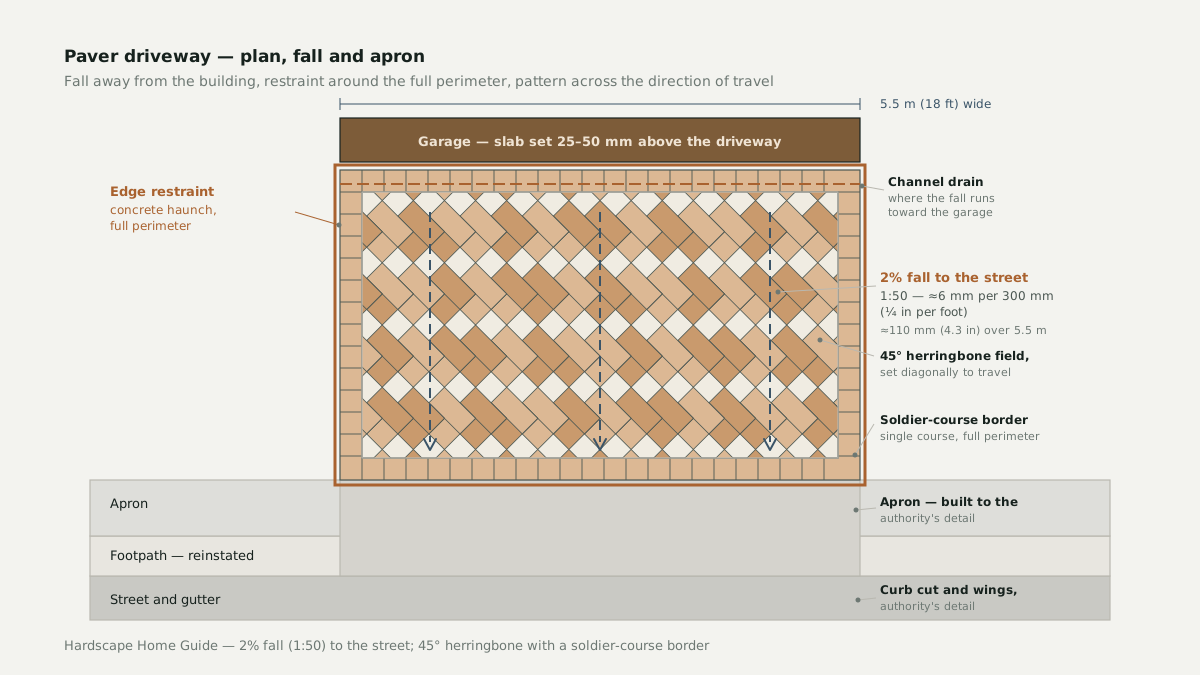
Driveway pavers are held by joint-sand friction, which is weak in shear, and by a rigid edge. The driveway detail is a concrete haunch cast against the edge course: minimum 150 mm (6 in) wide and 150 mm (6 in) deep in 3,500 psi (24 MPa) concrete, bearing on compacted subgrade rather than on the bedding sand. A 100 mm haunch is right for a patio and wrong here. Without it the sequence never varies — the edge moves, perimeter joints open, joint sand washes out, the edge units rock, and the loosening works inward a row at a time. Restraint runs the full perimeter, with an isolation joint against the garage slab.
Drainage, fall and the two interfaces
The design fall is 2% — 1:50, about 6 mm per 300 mm or ¼ in per foot. Below about 1.5% the surface tolerance of a hand-laid field produces local ponding even when the drawing says otherwise; above 10% (1:10) the driveway needs specific detailing, and above roughly 12% most authorities will not approve the gradient. Water that ponds finds the joints, then the bedding sand, then the base, then the subgrade — and once the subgrade is saturated, rutting starts.
The apron at the street
Where the driveway crosses the footpath and meets the curb, turning wheels at low speed apply the largest horizontal force the surface will ever see. In the US and Canada it is usually built to the city’s standard drawing and inspected; in Australia and New Zealand it is the vehicle crossing, paid for by the owner and separately approved. A few millimeters of step at the footpath edge is a trip hazard and a compliance problem.
The garage interface
Set the finished surface 25–50 mm (1–2 in) below the garage slab, falling away from the door. Above it, every storm drains into the garage; far below it, a step collects grit. Where a fall away is impossible, a channel drain across the full width in front of the door discharges to a soakaway or the storm system — never onto a neighbor’s lot, which most jurisdictions here prohibit.
Pattern: the case for herringbone
Pattern is structural before it is visual: interlock is how a wheel load transfers between units. Herringbone is the driveway default because units sit at right angles to each other and diagonally to travel, so a turning wheel pushing one unit is resisted in two directions instead of racking a row. On gradients above about 5% (1:20) the same interlock stops the creep that walks running bond out of alignment. Run the field continuously across the full width — a joint down the middle of a two-car driveway is a hinge — and border the perimeter with a soldier course held by the haunch.
| Pattern | Interlock | Cut waste | Best for |
|---|---|---|---|
| 45° herringbone | Two directions | ≈7% | Driveways, slopes |
| 90° herringbone | Two directions | ≈6% | Driveways |
| Running bond | One direction | ≈3% | Patios, paths |
| Basketweave | Moderate | ≈5% | Patios, accents |
| Stack bond | None | ≈2% | Not for driveways |
Cut waste is the share of the order lost to cuts at edges and around the apron.
Salt, freeze–thaw and cold climates
A driveway in Canada or the northern US sees 40–70 freeze–thaw cycles a year while carrying road salt and a loaded vehicle. Pavers handle that better than a rigid slab: the units move independently and the joints absorb movement instead of concentrating it into a crack. Two things still punish them. Chloride de-icers cause scaling (ASTM C672), and the vulnerable point is the joint, where salt water refreezes and takes out the friction holding the field together — use sand or grit, and prefer a chloride-free de-icer such as calcium magnesium acetate. Mechanical damage is worse: a steel shovel edge lifts units, so use a plastic blade and set snowblower skid shoes 5–10 mm above the surface. Frost heave is a drainage problem, not a depth problem — you do not excavate to frost depth, 1.2–1.8 m (4–6 ft) across much of Canada, to survive winter. Heave needs a frost-susceptible soil plus water, so specify a base with under 10% passing the 75 µm (#200) sieve. Sealing only helps if it is breathable; a film-forming sealer traps moisture and worsens freeze–thaw damage. In Australia and New Zealand the stress is UV and heat rather than frost, plus coastal salt spray and expansive clay in Victoria, Queensland and the Waikato.
Cost over 25 years, and repair
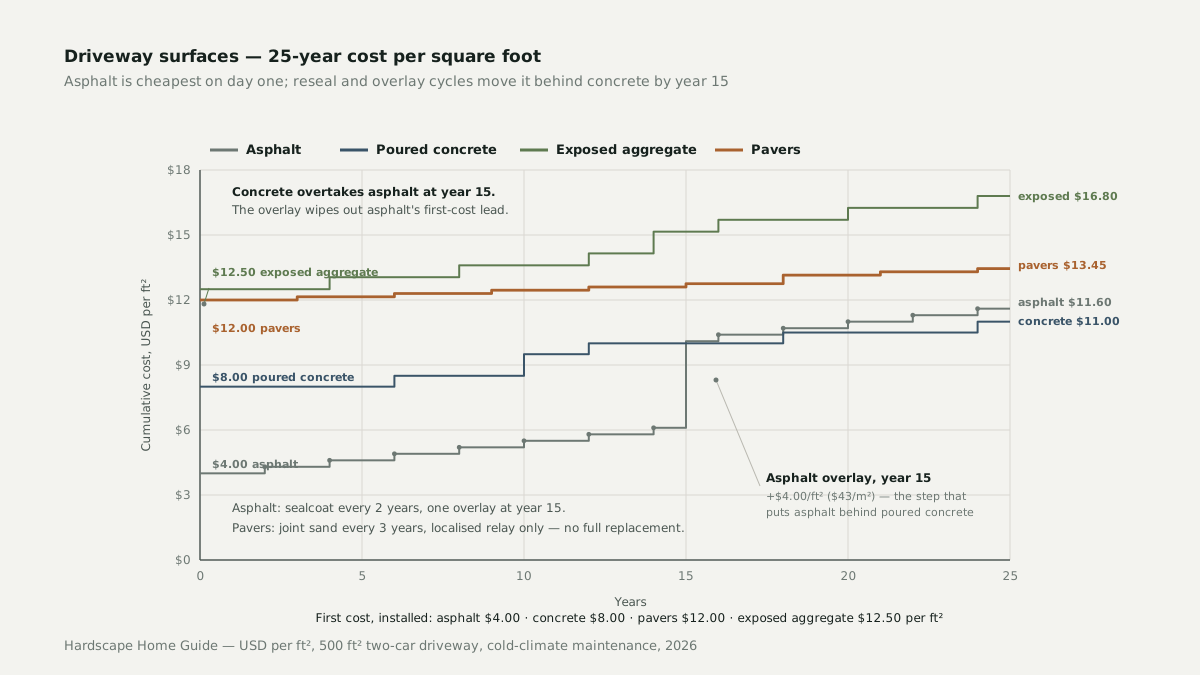
Driveway pavers are not the cheapest surface on invoice day. What changes the ranking is what each surface needs between years 1 and 25.
| Surface | First cost | 25-yr cost | Renewal events | Local repair |
|---|---|---|---|---|
| Asphalt | $3.50–$5.00 | $11.60 | Sealcoat every 2 yrs, overlay yr 15 | Patch only |
| Poured concrete | $7.00–$10.00 | $11.00 | Joint sealant, one panel replaced | No — full panels |
| Exposed aggregate | $11.00–$14.00 | $16.80 | Reseal every 4 yrs, panel replaced | No — full panels |
| Pavers | $10.00–$18.00 | $13.45 | Joint sand every 3 yrs, relay yr 18 | Yes — lift and relay |
USD per ft²; divide by 0.0929 for $/m², so $12.00/ft² is ≈$129/m². For a 500 ft² (46 m²) two-car driveway in a cold-climate market with regular de-icing; excludes drainage and regrading. Costs are regional and dated — 2026 planning figures, not quotes. In Canada, read the same numbers in Canadian dollars; in Australia and New Zealand, add 20–40%.
Read honestly, pavers finish about $2.45/ft² (≈$26/m²) behind poured concrete over 25 years. What that buys is the last column: pavers are the only surface here that can be repaired as a section rather than replaced. For a poured surface compared on its own terms, the concrete patio guide covers slab thickness and jointing, and the stamped concrete guide covers what a decorative finish adds to cost and maintenance.
Repairing a settled or rutted section
A rutted wheel track is a base problem showing through the surface, and topping it up with sand hides it for one season. Set a circular saw to the paver depth, cut the field to the nearest pattern repeat, lift the units and stack them, excavate the failed base, correct and recompact the subgrade, rebuild it in the same lifts to the same compacted depth, re-screed 25 mm of bedding sand and relay the original units. Expect $6–$12/ft² ($65–$129/m²) of repaired area, and order spares from the same lot at install so the repair is invisible. Find the cause first — usually a downpipe or gutter outlet discharging at that point, not the load.
Frequently asked questions
How deep should the base be under driveway pavers?
For a car on well-drained granular soil, 150 mm (6 in) of compacted crushed base; on firm plastic clay, 250 mm (10 in); on expansive clay, 350 mm (14 in). Add the 80 mm paver and 25 mm bedding sand for the total build-up. Place the base about a third deeper than its compacted depth, so 350 mm compacted means roughly 465 mm loose.
Can I use 60 mm pavers on a driveway?
No. The 60 mm (2.4 in) unit is the pedestrian standard for patios and paths; a driveway takes the 80 mm (3.1 in) vehicular unit. Bending resistance rises with the square of thickness, so a 60 mm unit has roughly 45% less stiffness, and the failure shows up as corner spalling and a rocking unit under a turning wheel rather than as a cracked paver.
What is the best pattern for driveway pavers?
45° herringbone. It interlocks in two directions, so a turning wheel pushing one unit is resisted by its neighbors instead of racking a whole row, and on gradients above about 5% it resists the downward creep that moves running bond out of line. It costs about 7% in cut waste against roughly 3% for running bond, and it needs a soldier-course border held by a concrete haunch.
How long do driveway pavers last?
Twenty-five years and beyond on a properly compacted base, with nothing but joint sand topped up every 2–3 years. On cumulative 25-year cost they land near $13.45/ft² (≈$145/m²) against $11.00/ft² (≈$118/m²) for poured concrete — about $2.45/ft² more, which buys the ability to lift and relay one settled section instead of replacing the whole driveway.
Sources and references
- Interlocking Concrete Pavement Institute — paver driveway construction and technical bulletins
- ASTM International — C936 solid concrete interlocking paving units; C672 scaling resistance
- CSA Group — CSA A231.1 and A231.2 precast concrete pavers
- Standards Australia — AS/NZS 4456 segmental pavers; AS 3727.1 residential pavements
- Cement Concrete & Aggregates Australia — pavement and aggregate technical guidance
